advertisement
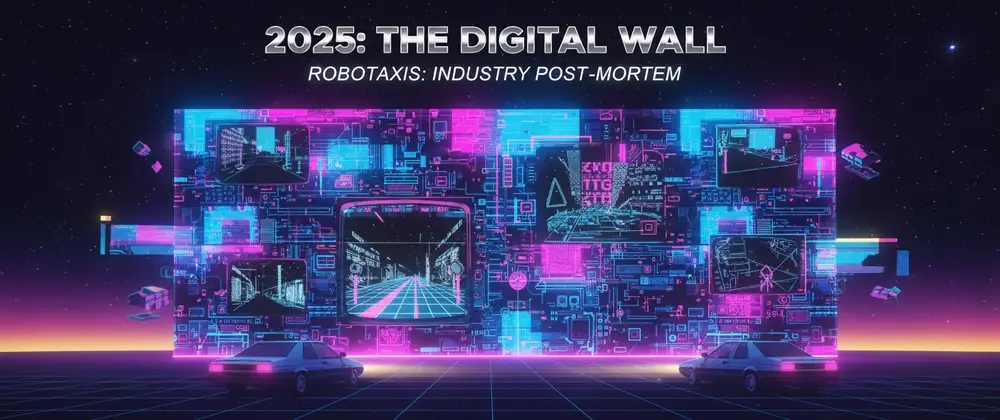
Why 2025 was the Digital Wall for Robotaxis: An Industry Post-Mortem
The fleets are on the ground. Applications are stuck. The once bustling "Robotaxi Hubs" in downtown Phoenix are now simply expensive parking lots with high-voltage chargers that no one uses.
This is the story of how we got to the Digital Wall. It's not just a story of sensor failures or budget cuts; is the story of the ghost we are chasing: the arrogance of believing we could replace human instinct with a billion lines of code. We wanted a servant who would never get tired; We built a calculator that couldn't look a pedestrian in the eye.
A deeply human look at the turning point of the autonomous vehicle industry in 2025: the empty charging centers, the laid-off safety drivers, the protests and the realization that we expected a servant and got a very expensive calculator.
Tags: autonomous vehicles, AI, transportation, urban planning.
Series: Deep Dives into Autonomous Systems
The current situation: 2026
Commercial Presence: Phoenix, SF, LA, Austin, Dallas, Houston, Atlanta; tests in Tokyo and London.
Fact: We no longer operate a commercial robotaxi fleet.
This is the story of how we got here and where we go next. But more than that, it's the ghost story we're chasing: the expectation that we could replace human instinct with code, that we could build a server that would never tire, never make mistakes, never disappoint.
We were wrong. And the ghost is still out there, haunting the vacant lots where the robotaxis used to load.
Part I: The dream that drove us
The promise of 2025
Five years ago we were all drunk. I admit it: I wrote some of those passionate articles myself. "The end of car ownership". "Your morning commute, reinvented." "Why 2025 is the year everything changes".
Every big automaker, every tech giant, and every ambitious startup had declared 2025 as the year of full autonomy. Robotaxis would dominate the city streets. Car ownership would become obsolete. The morning commute would be spent working, sleeping, or streaming, without looking at the brake lights.
We believed it because we wanted to believe it. The future was supposed to be clean, efficient and effortless. The future was supposed to arrive as planned.
The projections were intoxicating:
- 100 million autonomous vehicles on the roads by 2030 (Intel)
- $800 billion in annual revenue from autonomous mobility services (UBS)
- 90% reduction in traffic deaths (various industry claims)
- No human intervention required (literally every autonomy presentation)
Venture capital funding flowed like water. More than $100 billion was invested in autonomous vehicle technology between 2015 and 2023. Cities rewrote zoning codes for autonomous vehicle-ready infrastructure. Regulators rushed to create frameworks for a driverless future.
We built cathedrals for a god who had not yet arrived.
The geography of ambition
The business footprint told the story of American ambition, a map of places we thought would be transformed:
Phoenix emerged as the testing ground: wide streets, predictable weather and welcoming regulators. Waymo launched the world's first fully driverless ride-hailing service here in 2020. Cruise followed. The Valley of the Sun would be the valley of autonomy.
San Francisco represented the ultimate challenge and prize. Narrow streets, unpredictable behavior, dense fog and aggressive regulators. If you could make it here, you could make it anywhere. Cruise and W, the last giant standing, cautiously expands to Dallas and Orlando.
Los Angeles offered sprawl and scale: the traffic nightmare that autonomy would solve. The 405 at rush hour, the chaos of LAX, the labyrinth of surface streets that connect a hundred neighborhoods.
Austin became the new frontier. Texas welcomes regulations, South by Southwest as a showcase, and a growing tech ecosystem. It remains a ghost of its former self after the 2024-25 security withdrawal.
Dallas-Fort Wo
advertisement
Related Articles



advertisement