advertisement
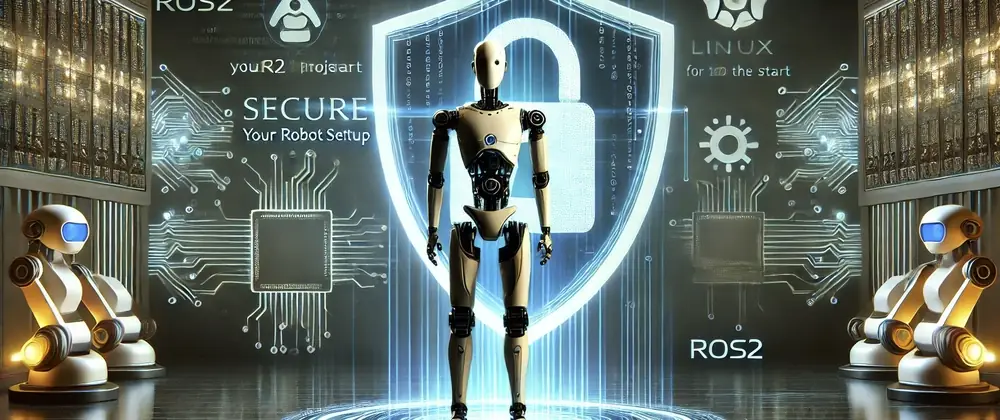
🔐 Securing ROS2 Nodes with SROS2: Encryption and Permissions for Robot Communications
In our previous post, we configured the firewall and gave $PROGRAMMER_LAPTOP_IP
access to the robot via SSH. But controlling a robot involves more than just external connections: a robot is a complex ecosystem of internal components, including a base controller, cameras, scanners, and motion modules. These components (ROS2 nodes) must communicate securely with each other.
So how do we ensure internal communication between ROS2 nodes?
📚 Table of contents
- Why node-to-node security is important
- What is SROS2?
- SROS2 configuration script overview
-
Step by step:
sros2_setup()
Bash function: security context summary
- Next steps: Intrusion detection with Suricata
Why node-to-node security is important
In robotic systems powered by ROS2, nodes constantly exchange data, some of it sensitive, such as motion commands or camera feeds. Without encryption or access control, this data is vulnerable to tampering or eavesdropping, especially in networked environments such as factories or research laboratories.
That's where SROS2 comes into play.
What is SROS2?
SROS2 (Secure ROS2) extends ROS2 with security mechanisms based on the DDS-Security standard. It uses OpenSSL to encrypt node communication and restrict access based on signed permissions.
When configured, SROS2 creates a keystore directory that contains:
- A Certification Authority (CA)
- Each node:
- Public certificate
- Private key
- Signed permissions file
This configuration ensures that only authorized nodes can participate in the ROS2 ecosystem.
SROS2 Configuration Script Overview
To simplify the configuration, we create a script: sros2_setup()
. This Bash function initializes a keystore and configures a node (base_controler
) for secure communication.
It is assumed:
- A working ROS2 installation
- ROS2 user and workspace configured in an external script (
common.sh
)
Step by step: sros2_setup()
knock function
1. Install OpenSSL
proper installation -y openssl
🔧 Ensures necessary cryptographic tools are available for SROS2 key generation.
2. Switch to ROS2 user
sudo -u "$ROS_USER" bash -c '...'
🏃 Run the configuration in the context of the non-root ROS2 user.
Inside the block:
a. Get the ROS2 environment
source /opt/ros/$ROS_DISTRO/setup.bash
🔗 Load the ROS2 environment variables.
b. Create the keystore directory
mkdir -p $ROS_WS/sros2_keystore
c. Initialize the keystore and create keys
security ros2 create_keystore $ROS_WS/sros2_keystore
security ros2 create_key $ROS_WS/sros2_keystore base_controler
🔐 Generate a secure identity for base_controler
node.
4. Define node permissions
Create a file with the following XML content:
2025-01-01T00:00:00
2027-01-01T00:00:00
0
*
*
📜 This permission file grants base_controler
node access to all topics on domain ID 0.
5. Generate signed permissions file
security ros2 create_permission $ROS_WS/sros2_keystore base_controler
✍️ Sign the permissions file using the CA to make it valid and executable.
Security Context Summary
With this function we now have:
✅ An initialized keystore for SROS2
✅ A certificate and key pair for base_controler
node
✅ A signed permission file that allows communication
✅ End-to-end encryption for internal robot node communication
In combination with the previous security steps (AppArmor, Auditd, and firewall configuration), we are creating a layered security model for our robot.
See code here
Next Steps: Intrusion Detection with Suricata
Now that encrypted communication is configured within the robot's internal architecture, the next step is to detect anomalies or intrusions in the network.
advertisement
Related Articles


advertisement